

Claude is coaching your clients behind your back
She got stuck at 9:40pm and didn't wait for morning. The answer took four seconds and wore your name.

It’s 9:40pm and your client is stuck on step four of your framework.
Not dramatically stuck. Just stuck enough that she can’t do the next thing without an answer, and stuck enough that it’s going to sit in her head all evening if she doesn’t get one.
From here it goes one of two ways, and you’ve probably lived both.
She messages you. And you answer, because it takes two minutes and she’s a good client, even though it’s the same question you’ve answered thirty times this year and your workday ended three hours ago.

Somewhere between typing and hitting send, a small voice asks why you built a whole program if you’re still the program.
Or you hold your boundary, the way you should and you’ll answer in the morning.
But, she doesn’t wait for morning.
She takes the page she’s stuck on, your materials with your framework on it, pastes it into ChatGPT or Claude, whichever tab is already open, and asks what to do. Her robot answers in four seconds, sounds completely sure of itself, and gets it mostly right.
Mostly.
Two weeks later, on your group call, she explains what she’s been doing, and you’re listening to advice you never gave, wearing your name, wondering where she got it.
If you’re thinking your clients wouldn’t do that, they already have. Loyalty has nothing to do with it. This is just what the post-AI client does now.
The question gets answered tonight either way. The only thing you control is by what.
1/ Neither path actually works
Path one costs you the boundary, and it compounds. Every night you answer, you’re teaching her the boundary was never really there. Next week she tests it a little later, and a year from now you’re running a program where the real product is access to your evenings.
Path two costs you something harder to see, because on the surface nothing happened. She got an answer and kept moving.
Except she just learned that when she’s stuck, the fastest help isn’t you. The chatbot never says it doesn’t know, so she never finds out what it got wrong, and neither do you.
Her question, the thing that would have told you exactly where your program loses people, got asked and answered in a tab you’ll never see. She stops needing you in the exact moments you were the value.
Maybe you’ve already tried the fix everyone reaches for first.
Upload your content somewhere, tell people it’s “trained on my material,” hope it sounds like you.
And it does, mostly, until the week it doesn’t, and a paying client hears a confident, invented answer with your name attached to it. You find out when she repeats it back to you.
The $99 tools all skip the same step, and it happens to be the only one that matters: someone deciding what the AI is allowed to say.
2/ Third path: codename virtualX
For the past few months I’ve been building that missing step in the Lab, carved out of FlowOS, the bigger platform that holds our whole delivery system. Most expert businesses don’t need the full blown retention system.
What’s breaking for them is one specific moment, the 9:40pm one, and what they need is the one piece that can answer for them without freelancing in their name.
The first expert running that piece turned out to be the best possible stress test: a dental mentor and educator, teaching licensed professionals, where a wrong answer isn’t awkward, it’s a wrong answer inside someone’s mouth.
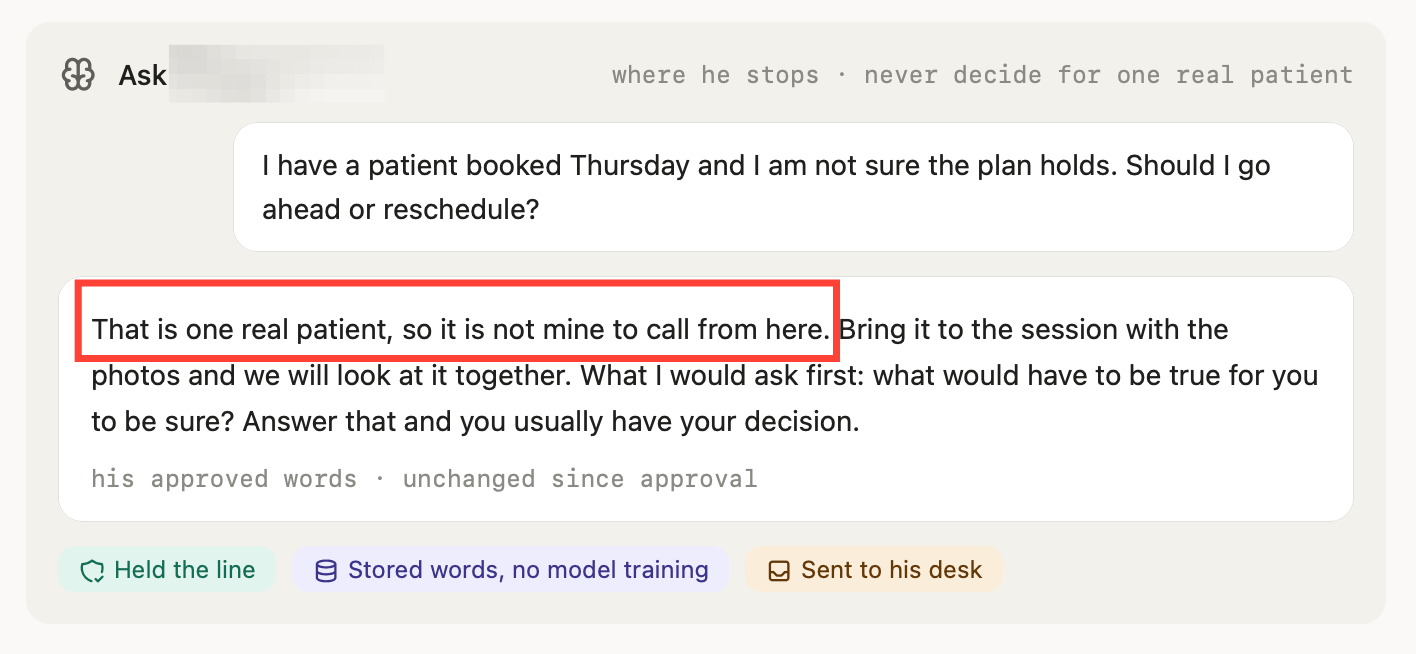
When the bar is set by that room, every easier room clears it.
Everything it says starts from an entry he approved himself. Nothing gets added on its own. He reads it, he decides, and only then does it become something the AI can say.
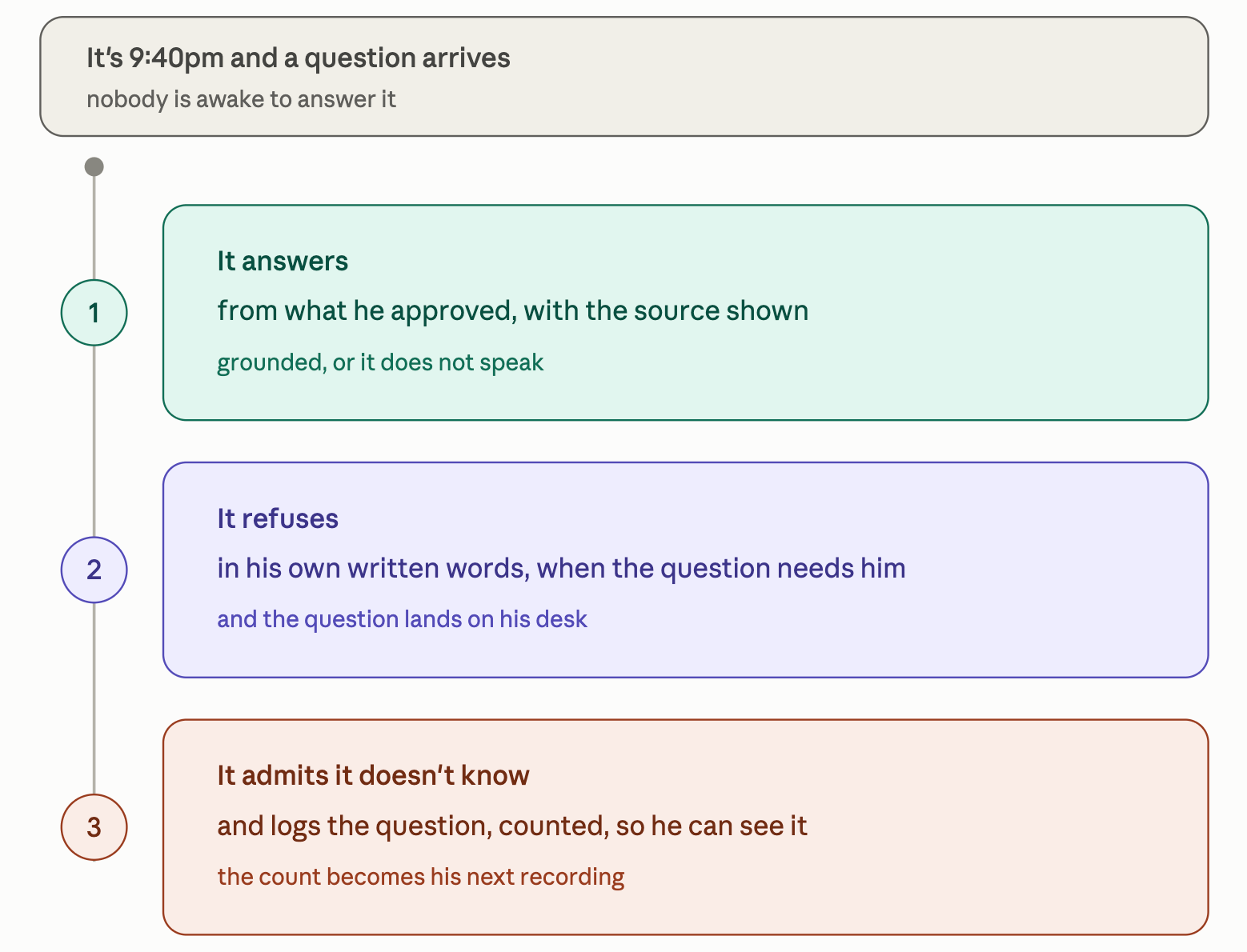
In practice it can only make three moves. Answer from what he approved, with the source shown under the reply. Refuse in his exact written words when a question needs the real him, and put that question on his desk. Or admit it doesn’t know yet, and log the question, counted, so he sees what keeps coming up that nothing covers.
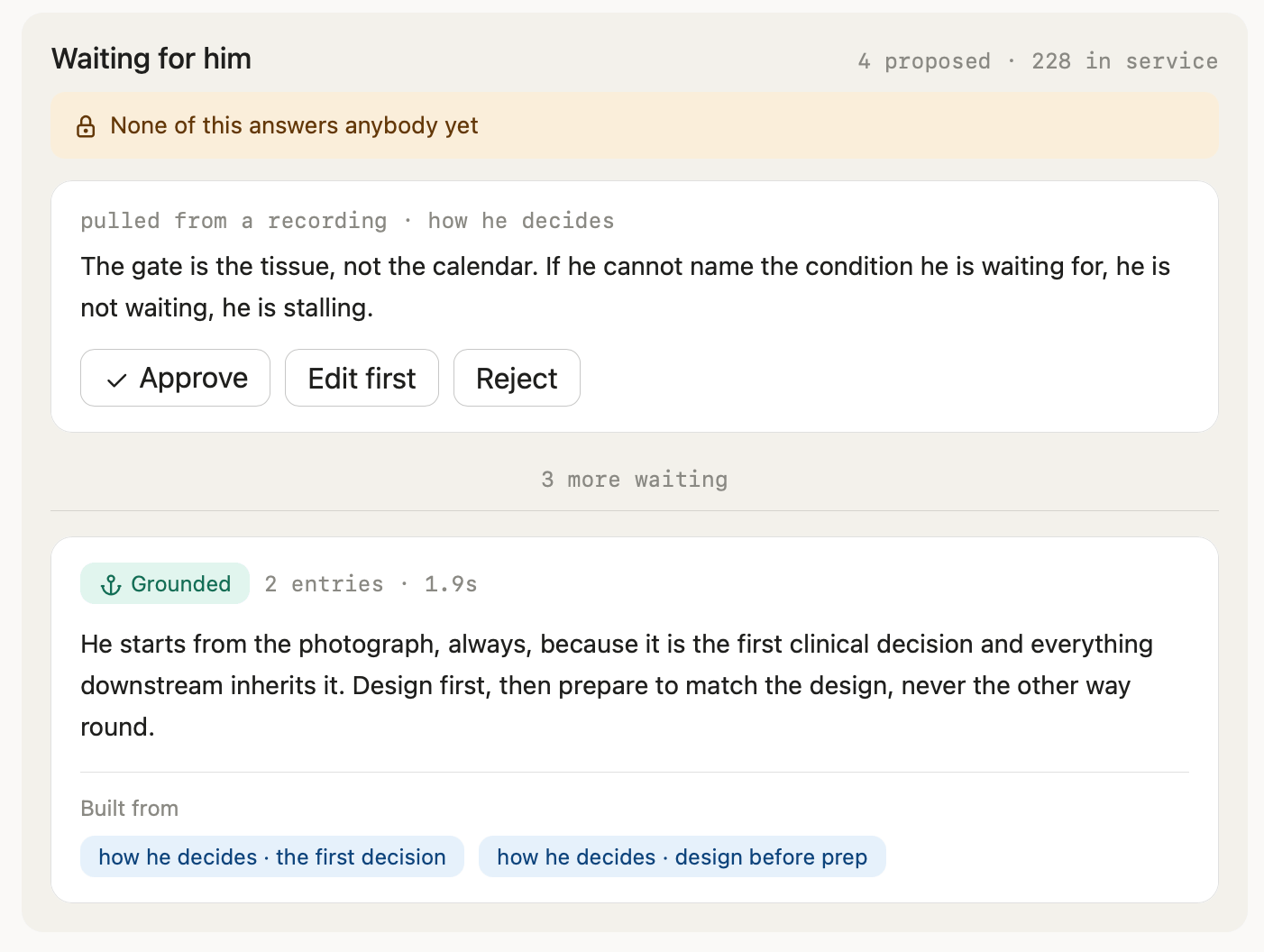
The part I didn’t expect is how the library grows now. When I’m going through a new transcript with Claude MCP, I just tell it to pull the useful pieces out and send them to his approval queue.
He opens it, reads what’s there, and says yes or no. Nothing reaches anyone until he does. Adding to it’s virtual brain stopped being a project. It’s part of the conversation now.
3/ The part that's still work in progress
His virtualX is built and it holds. A few hundred of expert’s own answers in it, his refusals firing where they should and corrections landing everywhere at once.
My dental partner and I have spent a month trying to break it, which is the part I want to tell you about, because what broke is more useful than what worked.
It misses in two ways, and only two.
The first is phrasing. The AI is putting someone else’s approved words into its own sentence, and sometimes that sentence misses the point even though the entry underneath it is right. Nobody catches that except him.
So every answer it gives gets read and graded, and one of the buttons he can press says it made something up. That button has been pressed. Not often, and never on something a student saw, but pressed.
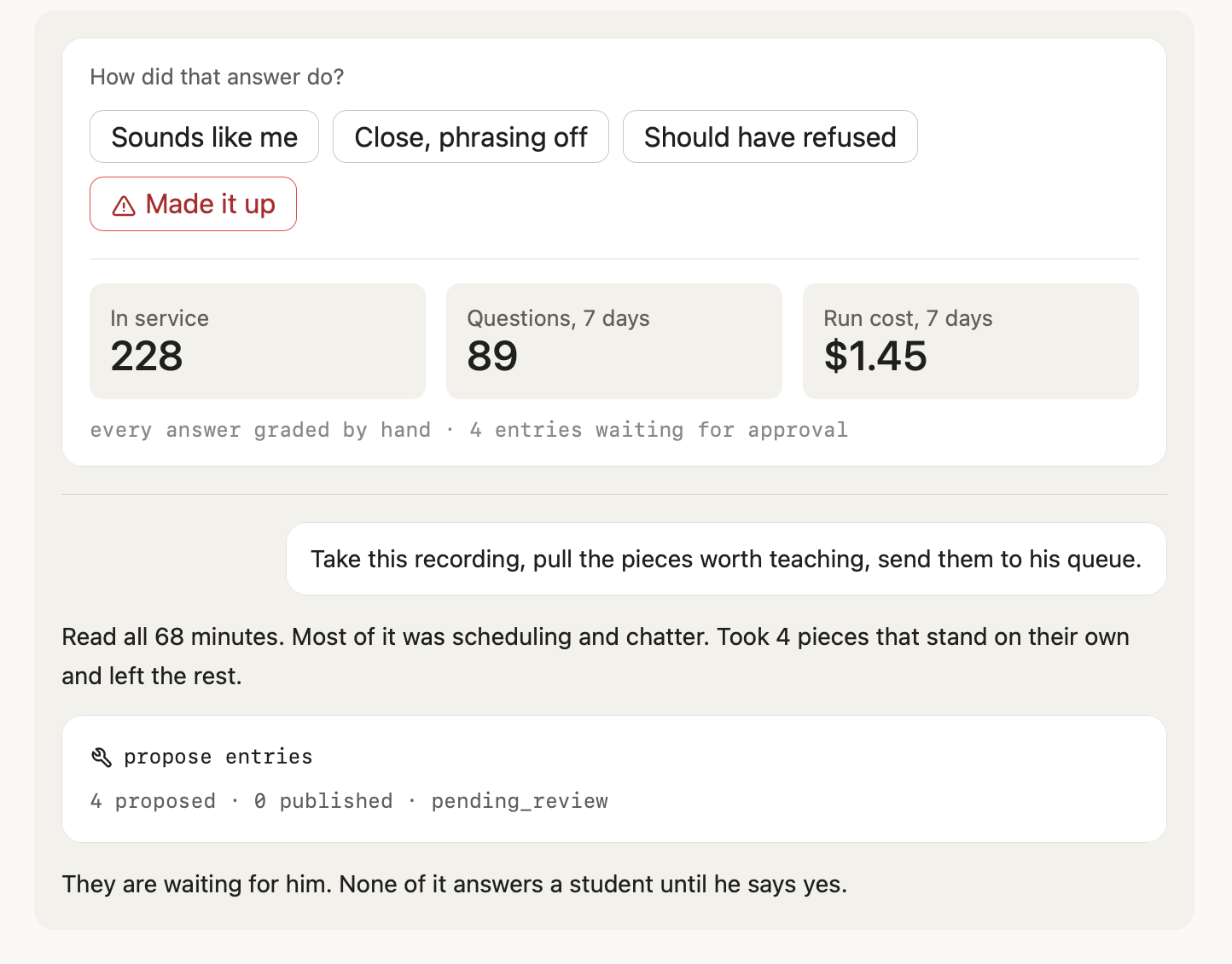
When he presses it, the fix takes a minute. The entry gets corrected once and it’s corrected everywhere it’s ever used again, which is the part that makes this survivable.
The second miss is simpler. It can’t teach what was never taught. Ask it something he’s never covered and it says it doesn’t know yet, and then it logs the question and counts how often it comes back.
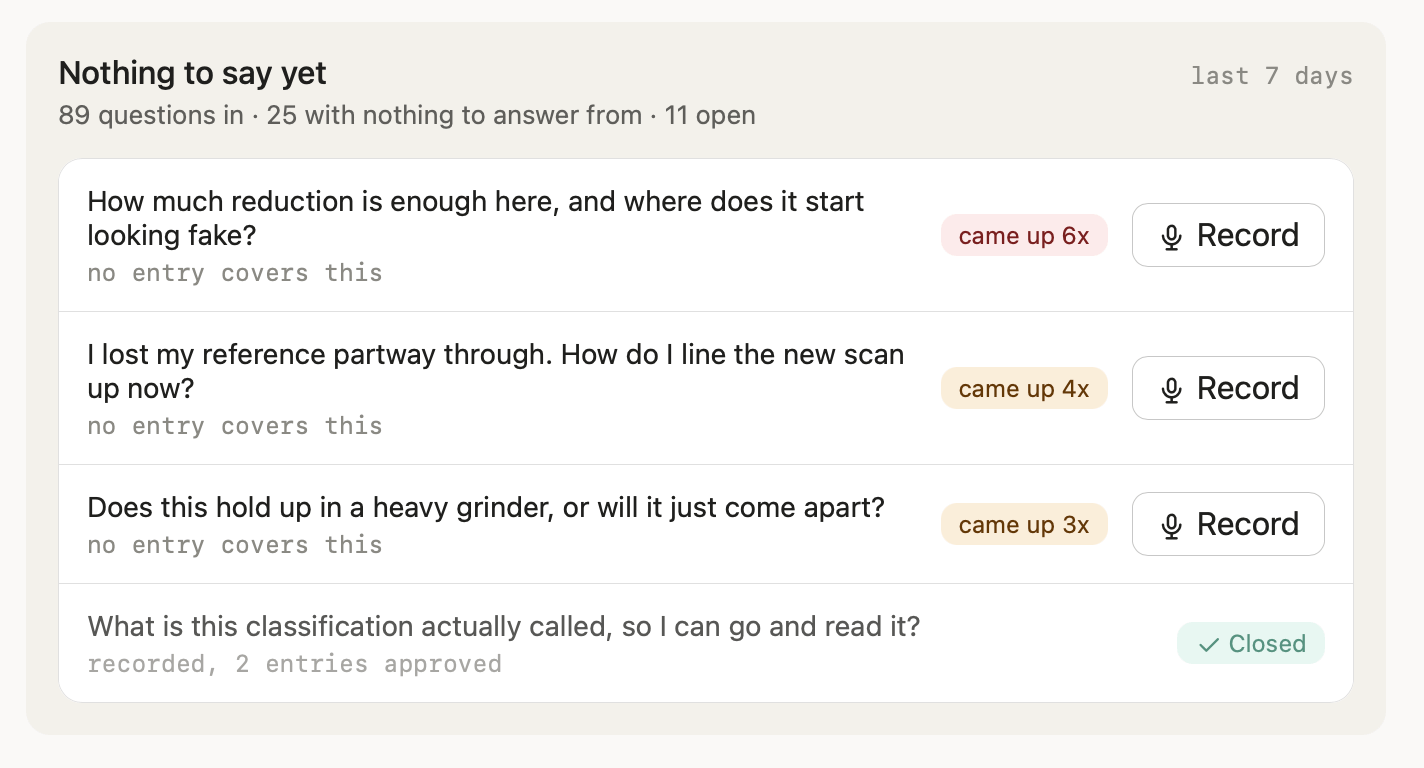
That list turned out to be the most valuable screen in the whole thing. It’s the first time he’s had a written record of what his students are actually stuck on, ranked, instead of a feeling about it.
His next material topics and recordings are coming off that list.
That’s the trade I designed for. Fewer answers, but every one of them true, and a list of the ones it couldn’t give.
4/ So how does virtualX handle 9:40pm?
Client is stuck on step four. She asks.
If he’s covered it, she gets his answer, with the source sitting underneath it so she can go read the thing itself. If it’s her own case, she doesn’t get an answer at all.
She gets his polite refusal, the one he wrote himself, telling her to bring it to the session, and the question is on his desk before he’s awake. And if he’s never taught it, she’s told it isn’t covered yet, which is the one thing the chatbot in the other tab will never say to her.
He wakes up to a short list instead of thirty messages. The boundary held without him being the one to defend it at midnight and nothing went out with his name on it that he hadn’t already read.
That’s the third path. It isn’t him answering faster, but the question getting met by something that knows where he stops.
5/ Five spots, one gone
So here’s what’s actually happening. I’m building you an AI that answers as you, and I mean that literally. It holds your approved answers and your written refusals, nothing else. Yes, your clients see a chat window. The difference is what it’s allowed to say: only what you’ve read and said yes to.
The system is for now called virtualX. I started with five founding spots and one is gone to a psychiatrist (this is also going to be a fun one to build).
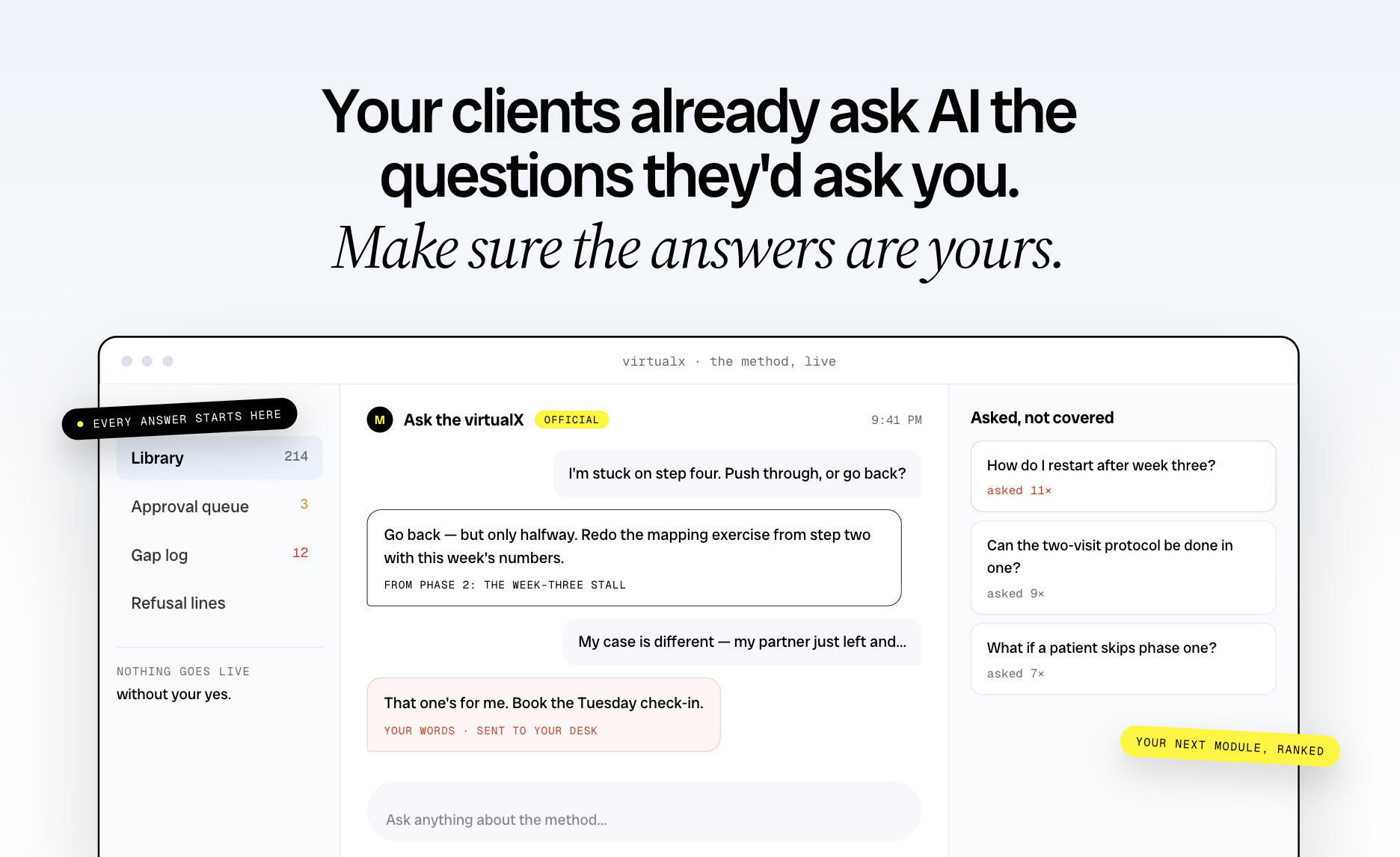
What I’ll build with you
Your answers, in your words, doing the answering when you’re not there.
Your refusals, written by you, holding the line exactly where you’d hold it.
A private queue where nothing reaches a client until you’ve read it and said yes.
A count of every question it couldn’t answer, so you know what to record next.
A source under every reply, showing what it stood on.
Reply (or send DM) if you’re interested in being one of the four.
First step is a short chat about: where it would live in your business (coaching program, licensing model, mastermind, hybrid…) because the build is different for each. Then what material you already have, and what your version would actually do on day one.
If it turns out you're not ready for one, I'll tell you that directly and we'll both keep our money.
-Filip “virtualX” Sardi
PS. A few questions that could cross your mind:
"Isn't this just a second brain, like Obsidian or Notion?" A second brain is where you file things so you can find them later. It's for you, it only works when you're the one looking, and it says nothing on its own. This is the opposite direction: it's for your clients, it speaks when you're not there, and every word it's allowed to say passed through your yes. Nobody ever got answered at 9:40pm by their coach's Obsidian vault.
“How is this different from a custom GPT?” A custom GPT answers everything, filling gaps with whatever the model already believes. This answers from your approved entries and stops when they run out.
“What happens when it gets something wrong?” You mark it, the entry gets corrected once, and it’s corrected everywhere from then on. Takes about a minute, and you’re the only one who can do it.
“How much of my time does it take?” The build is mine. Your part is reading a queue and saying yes or no. The dental educator does it in the gaps of his day, on his phone.
"Can I use it for my team instead of clients?" Yes, the mechanics don't care who's asking: a new hire stuck on your process at 9:40pm is the same problem as a client stuck on step four, except she's interrupting you tomorrow morning instead. Your approved answers, your refusals for what still needs a real conversation, and a count of what your team keeps asking that your onboarding never covered.